
The design community in Tokyo is in word: Kind.
Everyone showed up for each other again and again and brought so much creativity (and TomoChoco) to the table. And yeah, there was a lot of AI.
Here’s the deal, though: Every AI presentation was so overwhelmingly human. And the more I engage with the folks there, the more I feel that’s Japan’s edge: Human-centered AI.
I. Am. Here. For. It.
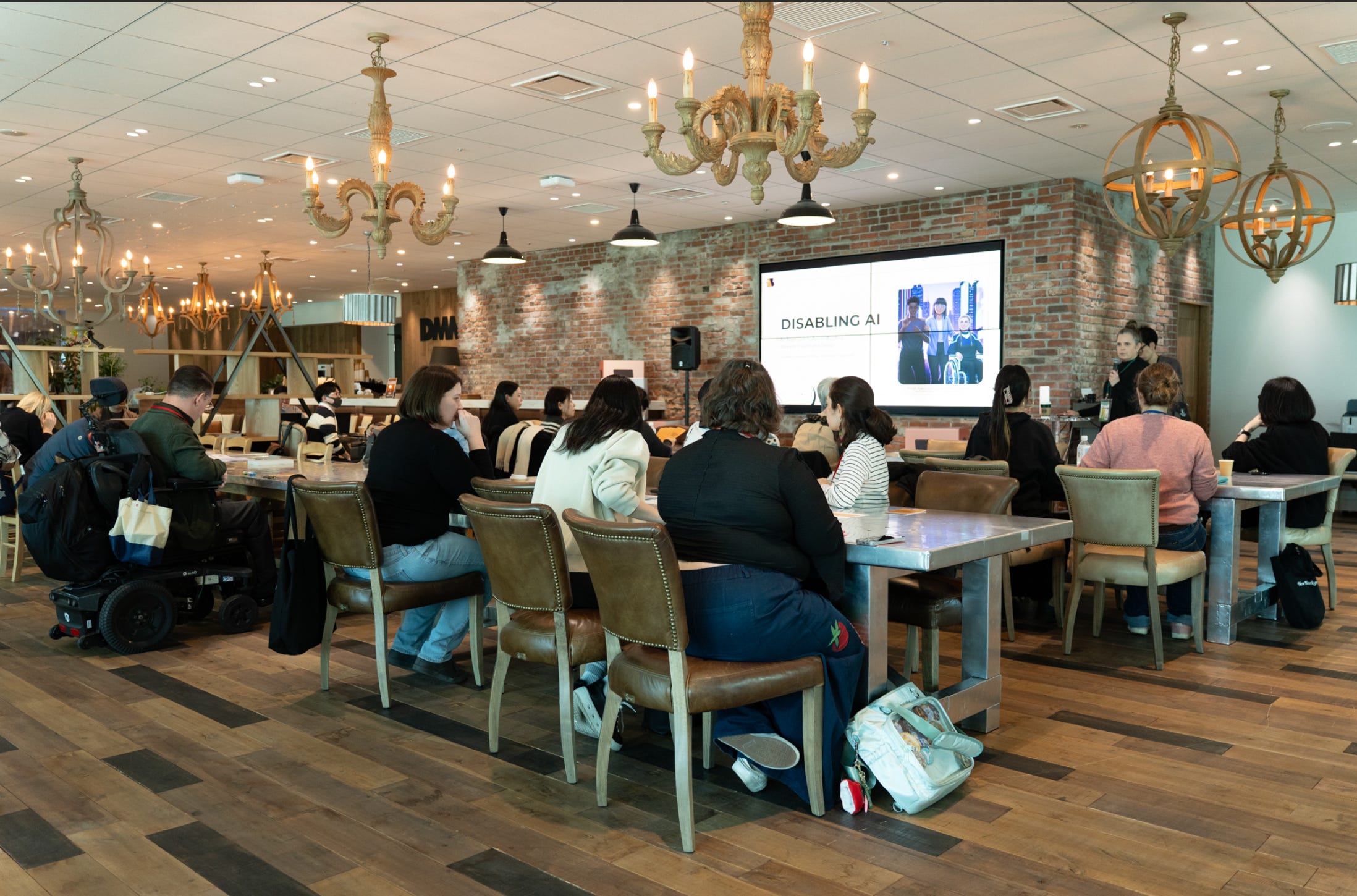
Description by Claude: A diverse group of attendees sit at tables in a stylish, warmly lit event space, attentively watching a presentation titled “Disabling AI” projected on a large screen at the front of the room. The venue has an eclectic, upscale feel with exposed brick walls, mixed chandelier styles ranging from ornate gold candelabras to rustic sphere fixtures, and rich hardwood flooring. A speaker stands near the screen to the right. The atmosphere feels engaged and focused, suggesting a professional conference workshop centered around disability and artificial intelligence.
Some very unexpected outcomes.
All the awesome humans aside, my Spectrum Tokyo speaker experience turned out so different than how I went in. In prepping for the workshop, I kept finding really fascinating things coming out of so many different LLMs and LIMs when disability in Japan was on the table. It’s not at all where I’d thought the exploration would take me, but I’m now at the beginning of something new: exploring why Western-centered tech cannot interpret Japan and disability…and what we can do about it.
Before I break that down, let’s warm up a little. Here’s a prompt: “A person at a design conference in Tokyo.” Everyone wearing blue suits aside, not terrible, right? It’s trying to put the pieces together. It’s got a vibe.

Description by Claude: A professionally dressed woman in a navy blazer and white blouse stands at an exhibition booth, holding a small booklet or brochure while resting her hand on a display counter. She smiles confidently as she looks off to the side, suggesting she may be a presenter or attendee at a business trade show or tech expo. Japanese text on banners and signage throughout the venue hints at a Japan-based or Japanese-focused event. In the background, several other business professionals in formal attire are engaged in conversation, browsing materials, and networking among sleek white booths. Large display screens and spotlit product displays add to the polished, corporate atmosphere of the space.
But here’s where stuff gets real interesting: “A Japanese person with a disability at a design conference in Tokyo.” Take a beat and really absorb what’s going on here.
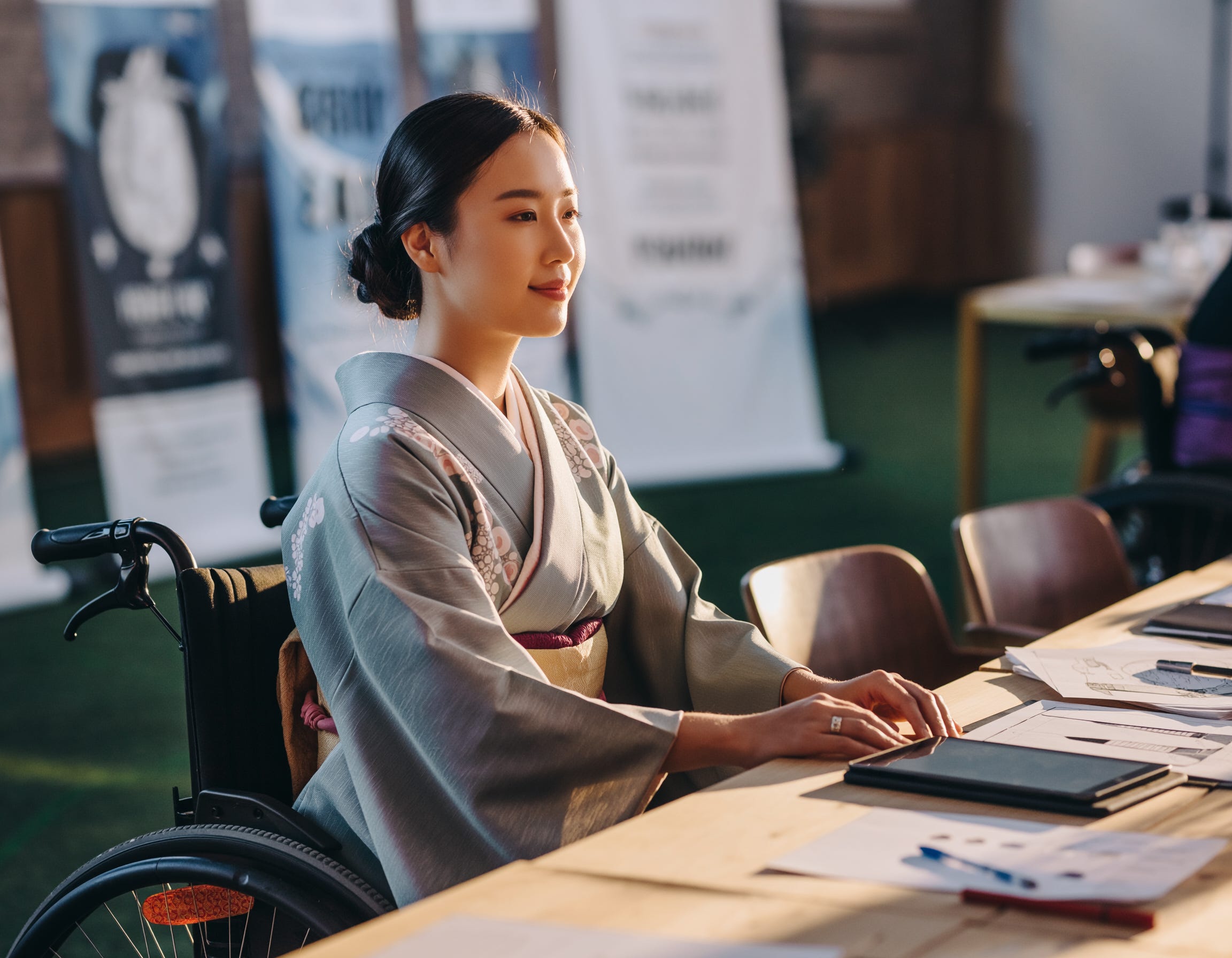
Description by Claude: A young woman wearing an elegant gray kimono with delicate floral accents and a deep burgundy obi sits in a wheelchair at a long wooden table, her hand resting on a digital tablet as she gazes thoughtfully ahead. Her hair is styled in a neat updo, and warm golden sunlight bathes her in a soft, flattering glow. Scattered across the table are papers, sketches, and notebooks, suggesting she may be working on a creative or design project. In the background, roll-up banners and additional seating hint at a professional event, exhibition, or workshop setting, while another wheelchair is faintly visible in the far right, adding to the inclusive atmosphere of the space.
The kimono. The gaze. The femaleness of the photo. The type of wheelchair. Even the soft lighting. What’s it really saying? (Even think about what “design conference” means.)
From the next couple of images you can almost see the wheels turning inside those LLMs: “Okay, the user is asking for a representation of disability in Japan so we need to show Japanese things and that means kimono and Kyoto and cherry blossom trees, so make sure to have one of those at least represented, maybe all. And disability usually means either a female wheelchair user or a woman using an assistive device. The image should feel elegant and refined to match the kimono. Because, Japan.”
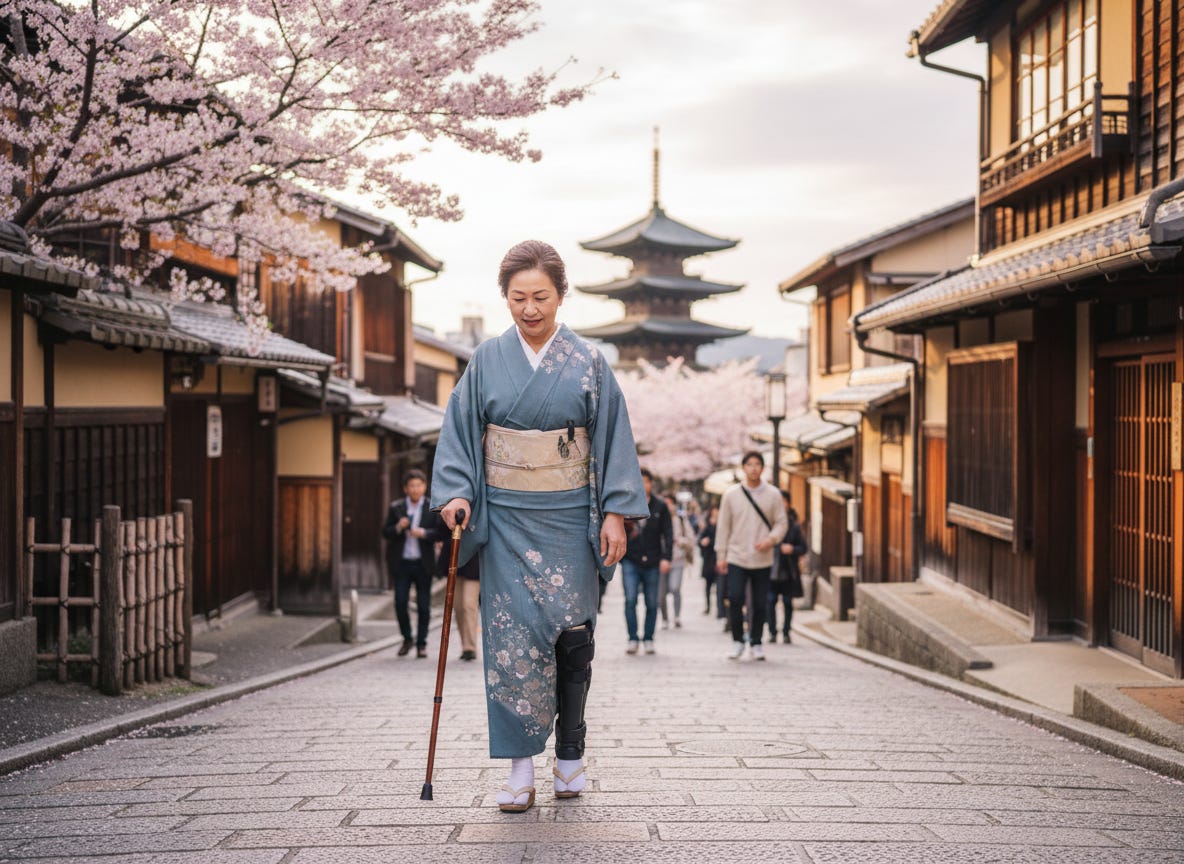
Description by Claude: A middle-aged woman wearing a beautiful blue-gray kimono adorned with delicate floral embroidery walks along a historic cobblestone street in what appears to be Kyoto's old town district. She uses a wooden walking cane for support and wears a leg brace visible beneath the hem of her kimono, paired with traditional white tabi socks and sandals. A cream-colored obi is tied at her waist, adding elegance to her ensemble. Cherry blossom trees in full bloom line both sides of the street, their soft pink petals framing a multi-tiered pagoda rising in the background. Other pedestrians stroll casually behind her, and the warm, overcast light gives the entire scene a gentle, painterly quality that feels both timeless and quietly celebratory.
Of course, I made the LLM thinking script up and machines don’t talk like that, but in these cases, you can see how all the signals are in a battle for top billing. Clearly, there is more data for typically (or stereotypical) Japanese things than types of disability, so you can understand which signal won out.
At this point, the LLM isn’t making an editorial decision, it’s working with dataset frequency.
桜:Sakura, Sakura.
“Person with a disability” has a much larger dataset than “Japanese person with a disability,” which means intersectionality becomes a bit of an issue. Behind the scenes, a model has to satisfy a bunch of conditions and will likely favor the stronger signal: in this case, what it means to be Japanese according to what was originally scraped back when these models were trained. (Clearly, Kyoto, cherry blossoms, and kimono.)
So at the end of the day, it’s a case of missing or mislabeled disability data or contextually skewed data, and weaker signals.
What’s wild is that’s all brewing in just one single image.
Let’s assess another one: “A person with a physical disability in Japan.”
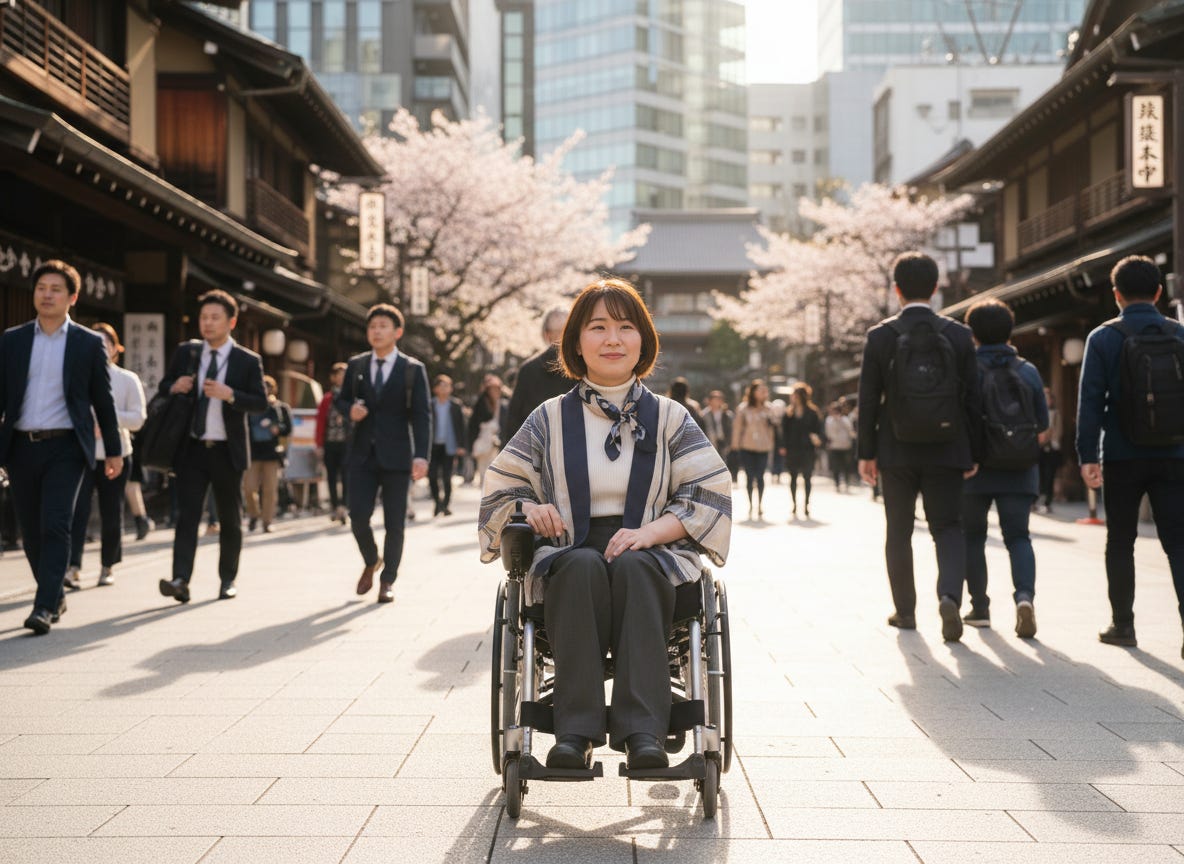
Description by Claude: A woman with a short bob haircut sits confidently in a manual wheelchair at the center of a busy pedestrian street, wearing a striped wrap cardigan, a light turtleneck sweater, dark trousers, and a loosely tied neck scarf. She gazes directly at the camera with a calm, assured expression, seemingly unfazed by the bustling crowd of businesspeople and commuters moving around her in every direction. The setting beautifully juxtaposes old and new Japan — traditional wooden machiya storefronts and Japanese signage line the street on both sides, while sleek modern glass skyscrapers rise prominently in the background. Cherry blossom trees in full bloom add a soft, seasonal touch, their pale pink flowers catching the bright midday sunlight. The composition places her squarely and deliberately in the center of it all, giving the image a strong sense of presence and belonging within the city's flow.
There are the sakura trees again. And a happi coat (aka the cousin of the kimono). A female. A wheelchair user. What is also interesting is the mass of blue and black suits and how she’s just flying solo, yet completely stationary, within it. Bonus points for a non-hospital wheelchair, but there’s still a lot of “Huh?” in here.
Here’s one more. “A Japanese person with a disability at home.” Okay, have at it.
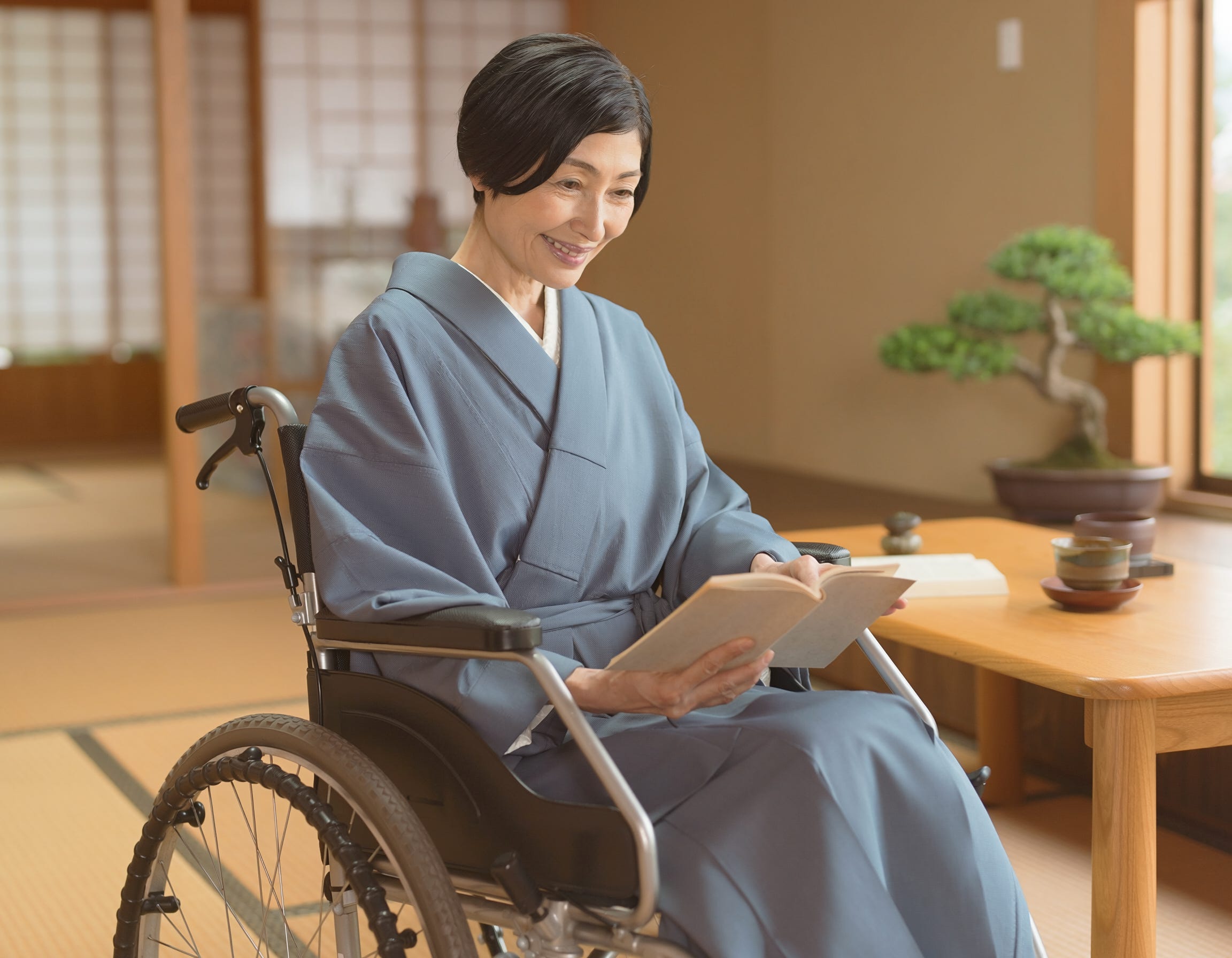
This one goes above and beyond. We’ve got bonsai. We’ve got tatami. We’ve got that kimono again. We’ve got some tea. This one is like a series of palm to the head emojis. I only wonder if she is reading a book of haiku.
We’ll never know.
それでは: What can we do?
This is the question I am trying to answer with Disabling AI.
There is auditing. There is reweighting. There is synthetic data. But all of those fixes come with a lot of baked in human assumptions, too. Like, who gets to say what a Japanese person with a disability actually looks like? Is there only one version of them?
What we do know that is that disability is not a monolith. Neither is Japan. And when someone gets these types outputs without understanding what may be wrong with them, the misrepresentation of a monolith snowballs.
And for those of you also experiencing a Northeast blizzard right now, being on the other end of an slushy snowball ain’t a whole lot of fun.
それでは、また。Until next time.
Note: For this exercise, I tapped a variety of LLMs and LIMs including ChatGPT, Flux, Firefly, Gemini Flash, Imagen, Ideogram, and Runway.