
Hello, Seattle.
Just back about a week from the awesome Microsoft Ability Summit and jazzed to keep growing Disabling AI.
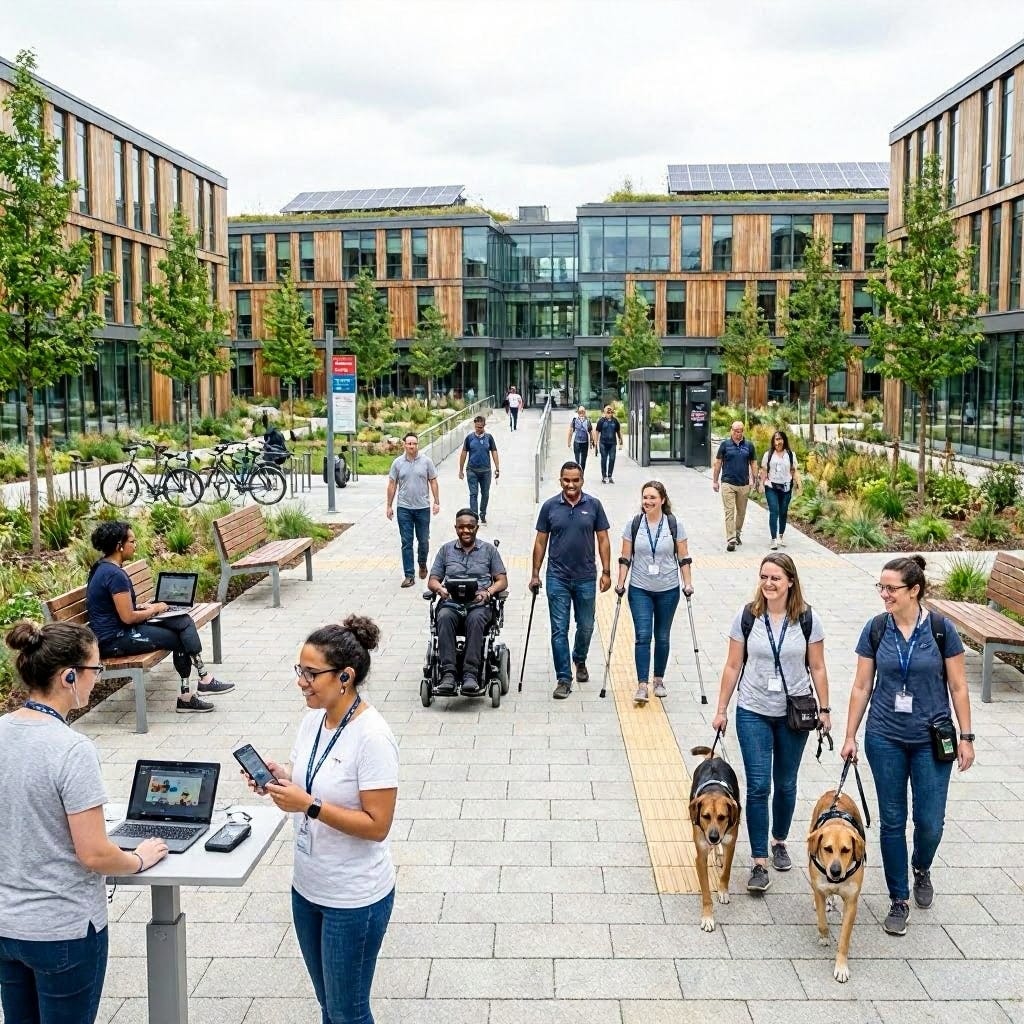
First off, Redmond and the Microsoft campus are otherworldly. Green, calm, connected, cool. It was hard to wrap my head this space as a New Yorker where concrete, noise, and pure panic are more the everyday vibe.
This was the first time Microsoft has held Ability Summit in person in, I think, nine years and once through the door of the convention center, the gravity shifted. People with disabilities were running the show. Power chairs, ASL, captioning, sensory rooms, assistive tech, accessible packaging, canes, and lots of canines.
Basically, a world where ableism just isn’t.
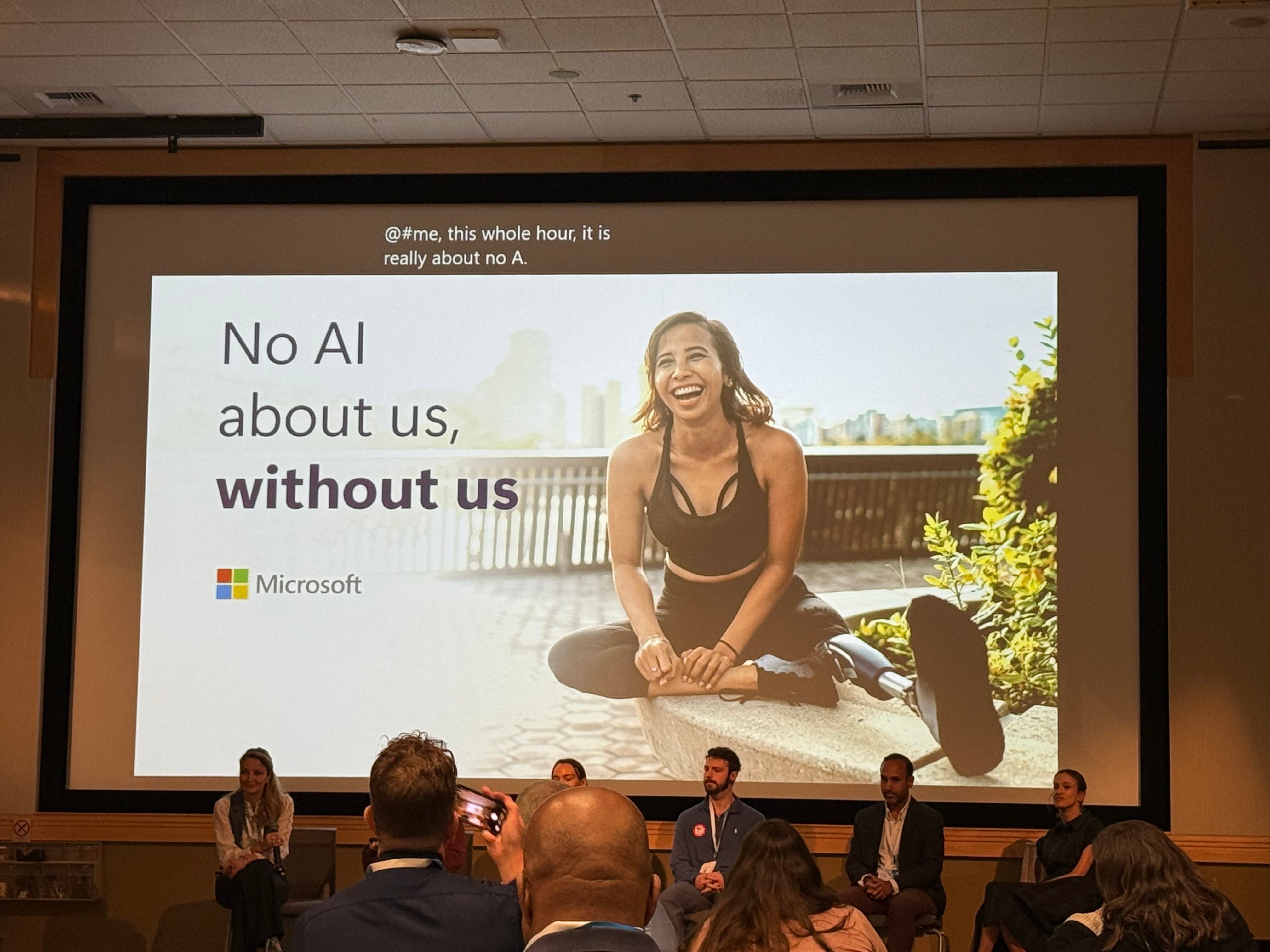
No AI about us, without us.
Flipping back in my notebook from the “Designing AI for Disability Representation” panel, I have a scribble in the margin that says: “Best. Session. Ever. Yay.”
Clearly, this Disability Studies and AI design dork was excited to be there.
From past posts, you already know that first part of this Disabling AI project is all about image and representation and nudging folks to understand how AI represents disability and how to change outputs—and outcomes. And, as it turns out, some awesome folks at Microsoft and their partners are doing the exact same thing.
First up was a Microsoft research preview of their “Engaging Communities Meaningfully in Defining Disability Representation for AI Image Generation” paper. I’ll drop the link below, but this paper is fantastic. In a nutshell, they talk about things like “preferred model representation,” and how they went and spun up a community library of 400+ images for model training. Even neater, they built an AI image evaluator to assess how well they had done with community scores.
Built for the community by the community.
Now, the sexy part of this conversation is “preferred representation,” so I am making sure NOT to gloss over it. It’s not about images of who non-disabled people think disabled people look or act like. It’s about what the collective community believes is preferred, and guess what, they made these preferences available on Hugging Face for free.
It’s a move like that empowers everyone to shape AI.
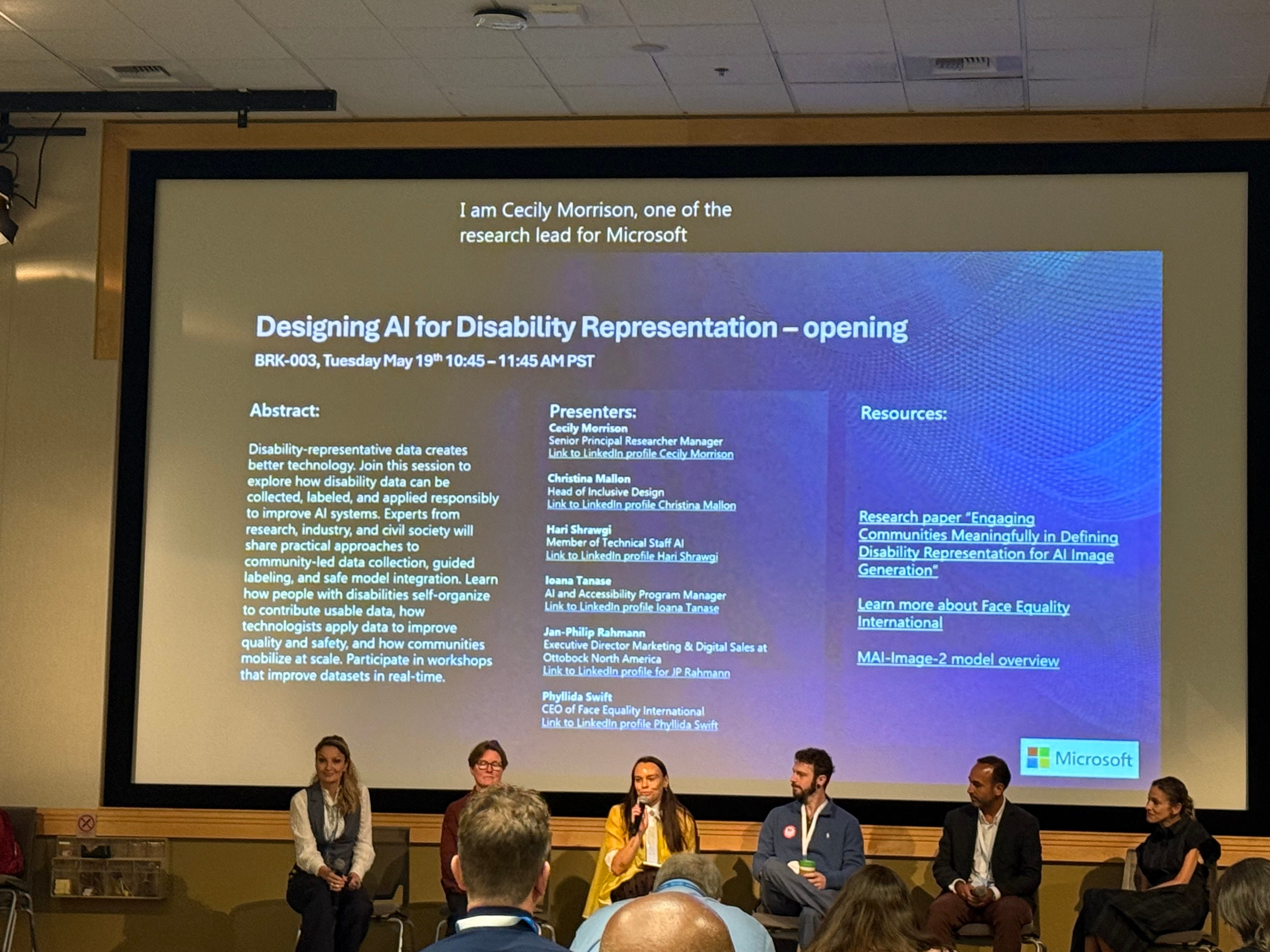
The next incredible presenter was the CEO of Face Equality International, which is focused on amping up representation for the facial difference community, an often-overlooked group in disability. Not only is their work focused on better Gen AI outputs, but they are also rallying to do better by the community and call out facial recognition inequities in places like banking apps and airport screenings.
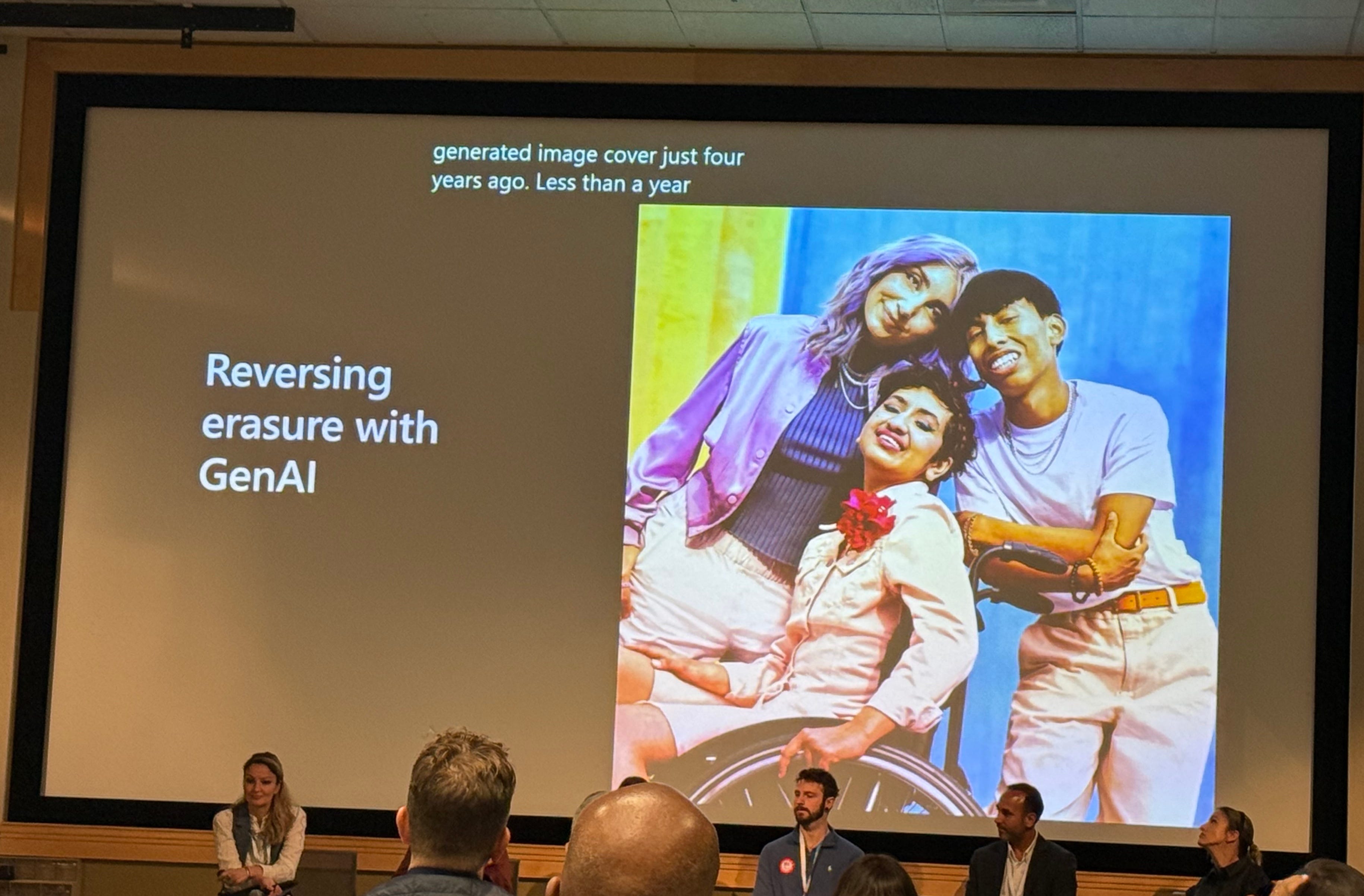
Reversing Gen AI Erasure
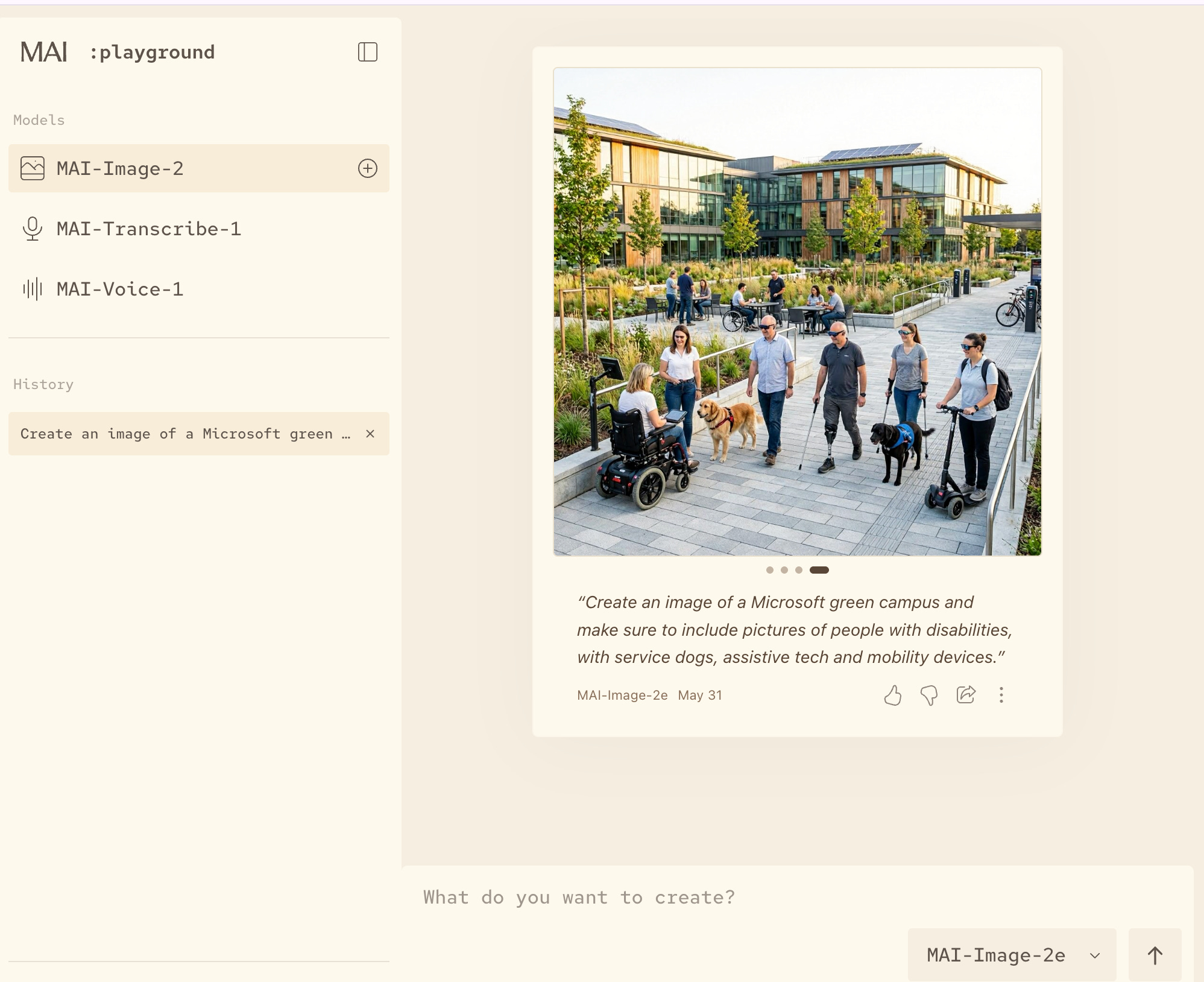
The last piece of the panel covered Microsoft’s proprietary MAI-Image-2 model which is helping to help flip the script on disability representation and focuses on more authentic outputs.
Per the conversation, Gen AI is still not great at showing mobility devices or assistive tech (which my own research proves true). But much like the Disabling AI cards encourage, it’s important to ask the models to give you multiple options. And, make your inputs as specific as possible.
One day we might not have to depend so much on the prompt, but as Microsoft’s inclusive design lead says, ”it’s important to experiment to get the right image.”
Give MAI-2 a spin: https://playground.microsoft.ai.
(Note: The accessibility is questionable here, which is kind of odd, but the multi-modal inputs are a bonus.)
What’s next.
I’m still digging through my notebook and the amazing amount of one liners I took home with me. But, so far, there’s one that has really stuck with me:
“The future of AI depends on who is building it.”
Guess I’ll take that as a call to action.
Sources
Thieme, A., Faia Marques, R., Grayson, M., Balachandar, S., Cassidy, C. T., Choksi, M. Z., Longden, C., Huda, R. S., Kalovwe, N. I., Mallon, C., Mansperger, C., Massiceti, D., Mitra, B., Nzioka, R. M., Tanase, I., You, Y., & Morrison, C. (2026). Engaging communities meaningfully in defining disability representation for AI image generation. In Proceedings of the 2026 CHI Conference on Human Factors in Computing Systems (CHI ‘26). ACM. https://doi.org/10.1145/3772318.3790768
Face Equality International. (2026). Face Equality International.